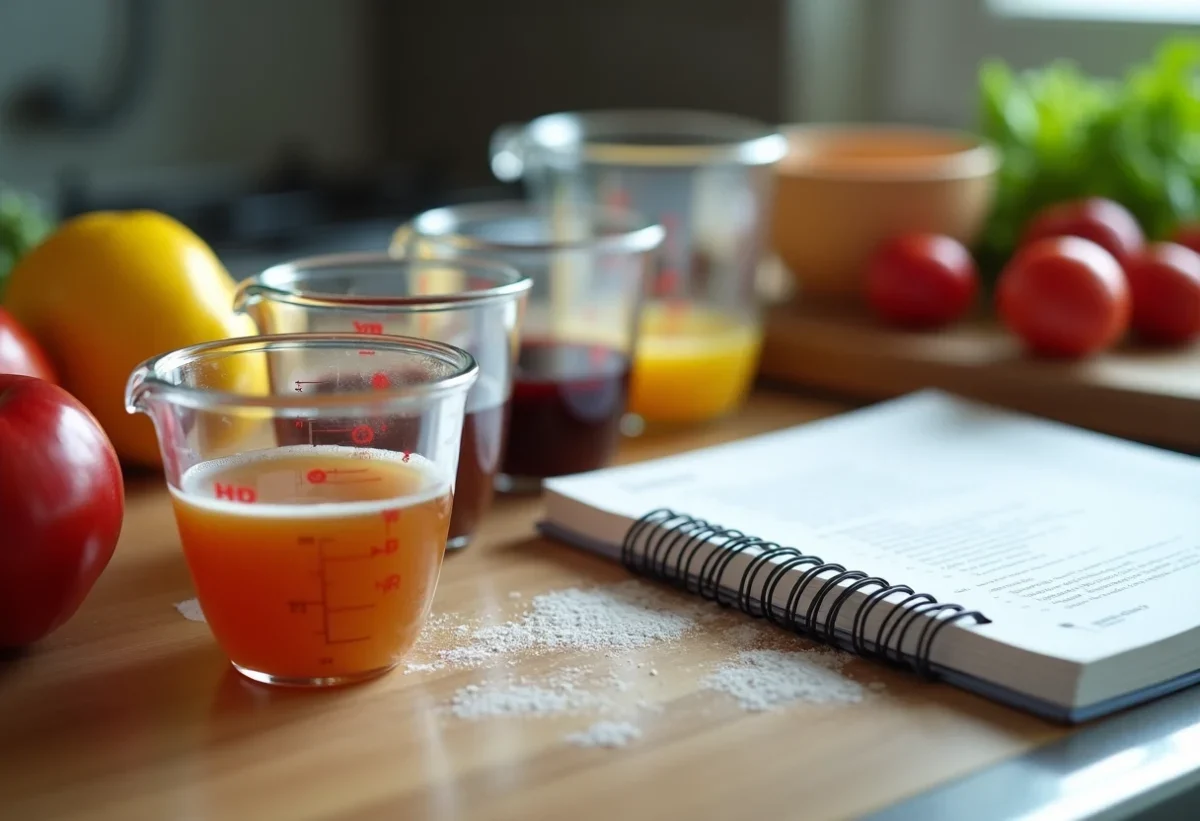
In cooking, recipes often require precise conversions of liquid measurements to achieve perfect results. A good understanding of equivalences is essential to avoid mistakes and ensure the success of your dishes. Using appropriate tools, such as measuring cups and scales, can make all the difference.
Mastering conversions between different units, particularly between milliliters and cups, allows for easy adaptation to international recipes. A few tips, like remembering that 240 ml equals one American cup, greatly simplify the task. With a bit of practice and some memory aids, conversions become child’s play.
The Basics of Liquid Measurement Conversion in Cooking
In cooking, the precision of measurements is fundamental to ensuring the success of recipes. The most common units of measurement for liquids include milliliters, centiliters, and liters. Understanding the equivalences between these units facilitates conversions.
- 1 liter = 1000 milliliters
- 1 centiliter = 10 milliliters
- 1 cup of liquid = 250 milliliters
For small quantities, tablespoons and teaspoons are frequently used:
- 1 tablespoon = 15 milliliters
- 1 teaspoon = 5 milliliters
The Densities of Ingredients
The conversion of liquids is not limited to volumes. The density of ingredients also plays a fundamental role. For example, water has a density of 1 g/ml, meaning that 1 milliliter of water equals 1 gram. In contrast, oil, with a density of 0.92 g/ml, is lighter. Here are some common densities:
- Water: 1 g/ml
- Oil: 0.92 g/ml
- Flour: 0.59 g/ml
- Sugar: 0.85 g/ml
- Milk: 1.03 g/ml
Example of Conversion
Let’s take a concrete example: converting 200 ml to cl. Use the relationship 1 cl = 10 ml. 200 ml equals 20 cl. This type of conversion allows for easy adaptation of recipes based on the units used.
Conversions between measurement units are an essential skill for any cook wishing to succeed in their recipes with precision. Follow these basics, and you will navigate easily between milliliters, centiliters, and liters. 
Tips and Practical Advice for Accurate Conversions
To master conversions in cooking, use appropriate measuring tools. A kitchen scale allows for precise measurement of solid and liquid ingredients. A measuring cup is essential for liquids, with graduations in milliliters, centiliters, and liters.
- Kitchen scale: used to weigh solid and liquid ingredients.
- Measuring cup: useful for measuring liquid volumes accurately.
- Measuring spoons: for small quantities, like tablespoons (15 ml) and teaspoons (5 ml).
Conversion charts are valuable allies. Display one in your kitchen for quick access. Use mobile apps for conversions in a flash.
Example of a Conversion Chart
| Unit | Equivalence |
|---|---|
| 1 liter | 1000 milliliters |
| 1 centiliter | 10 milliliters |
| 1 cup | 250 milliliters |
| 1 tablespoon | 15 milliliters |
| 1 teaspoon | 5 milliliters |
Consider the density of ingredients for accurate conversions. For example, a cup of flour (120 g) does not weigh as much as a cup of sugar (200 g).
Follow these tips, and you will ensure accurate conversions, making your recipes foolproof.