
Women’s centers in Quebec offer a variety of support options, from phone listening services to emergency housing. For someone seeking support, the challenge lies not in the lack of resources, but in choosing a structure that fits their situation. Comparing contact methods and services offered allows for quickly identifying the right organization, without unnecessary steps.
Contact and welcome methods: what distinguishes women’s centers
Women’s centers do not all operate on the same model. Some prioritize walk-in services, while others structure their offerings around scheduled meetings. The table below summarizes the main observable differences based on public information from several organizations.
| Criterion | Typical walk-in center | Typical appointment-based center |
|---|---|---|
| First contact | Phone or walk-in during opening hours | Online form or call to schedule an appointment |
| Access time | Immediate (depending on availability) | Variable, sometimes several days |
| Confidentiality | Ensured, but shared space | Private office, individual interview |
| Medium-term follow-up | Possible, but less structured | Personalized support plan |
| Complementary services | Referrals to partners, documentation | Workshops, exchange groups, legal support |
An organization like Entr’Elles in Granby combines several of these approaches. For women who wish to contact the Centre de Femmes Entrelles, the option to reach the team by phone or to visit in person lowers the barrier to taking the first step.
Personalized support: what services beyond listening
Active listening forms the foundation of most women’s centers. However, personalized support goes far beyond a simple conversation. It includes concrete interventions that touch on several dimensions of daily life.
Individual support and feminist intervention
Trained practitioners in intersectional feminist intervention offer individual meetings to address crisis situations, violence, or precariousness. This approach is not limited to psychological support: it aims to empower women in their journey.
The helping relationship often includes a practical component: assistance with writing letters, accompaniment to a lawyer or legal aid, support for understanding administrative documents or establishing a budget.
Collective activities and social integration
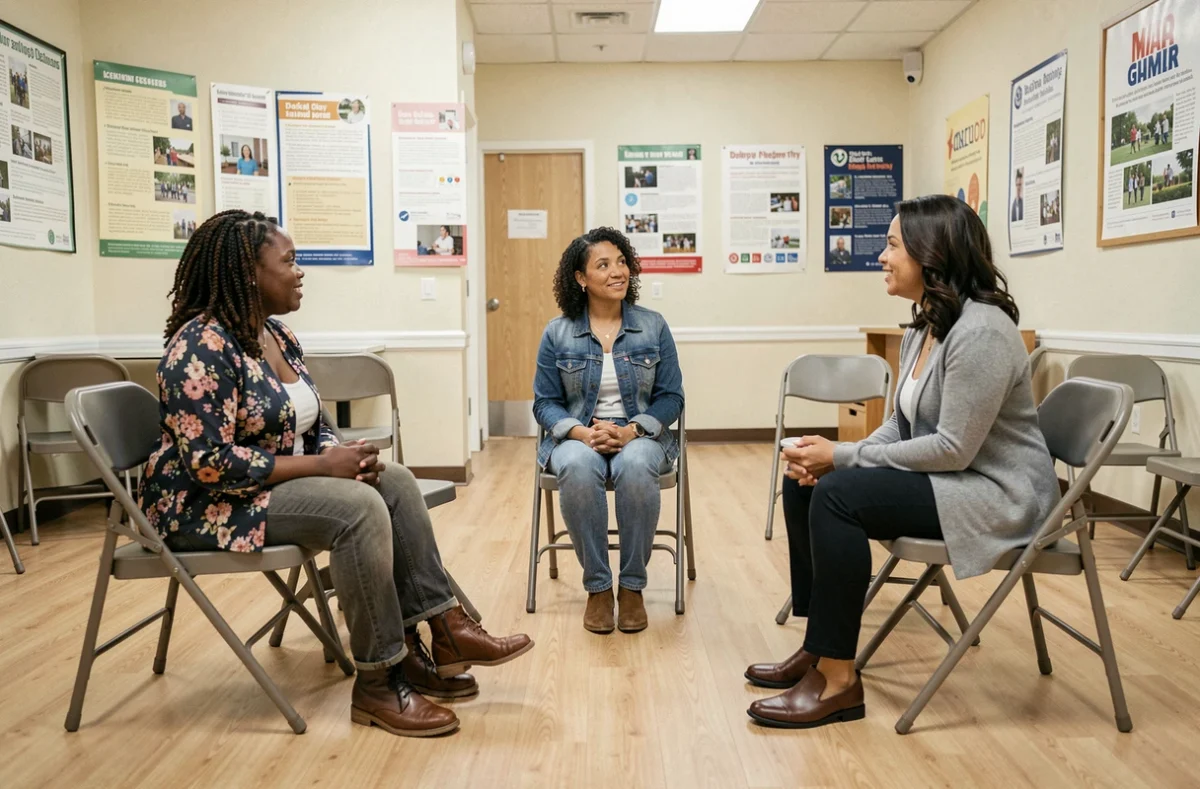
Women’s centers also structure their offerings around educational activities and exchange groups. These spaces help break isolation, a worsening factor in situations of violence or precariousness.
- Thematic discussion groups (self-esteem, health, women’s rights) led by qualified practitioners
- Practical workshops related to employment, professional retraining, or skill development
- Collective actions around awareness days (women’s rights, combating violence)
These activities are not just simple animations. They serve as a lever for social integration for women in isolation or life transition.
Crises and housing: when support becomes urgent
Some women’s centers have crisis shelter services, intended for women who need an immediate safe space. This aspect clearly distinguishes organizations that offer daytime support from those that provide comprehensive care.
The demand for help often exceeds available capacity, making the first contact even more crucial.
For women victims of violence, the speed of the first call can change the trajectory of a situation. A center that offers both a phone line, physical reception, and referrals to specialized partners provides a more comprehensive safety net than a service limited to a single channel.

Becoming a member of a women’s center: access to services and commitment
Membership in a women’s center opens access to the entire programming and services. The process is generally simple: a call or a visit is enough to register.
- Members have access to workshops, support groups, and events organized throughout the year
- Member status also allows participation in the organization’s direction during general assemblies
Becoming a member does not imply an obligation for regular participation. A woman can join to benefit from a single occasional service, such as legal support, and then return months later for another reason.
A community-based associative project
Women’s centers do not operate in isolation. They work in partnership with health organizations, social services, employment resources, and local associations. This referral capacity provides a concrete added value: a practitioner directs to the right service without the person having to start their journey from the beginning.
The choice of a women’s center is based on practical criteria (proximity, hours, contact methods) as well as the nature of the services offered. Women seeking personalized support benefit from checking whether the organization offers structured individual follow-up, collective activities, and a network of partners. It is this combination that makes the difference between a simple listening space and a true transition space towards autonomy.