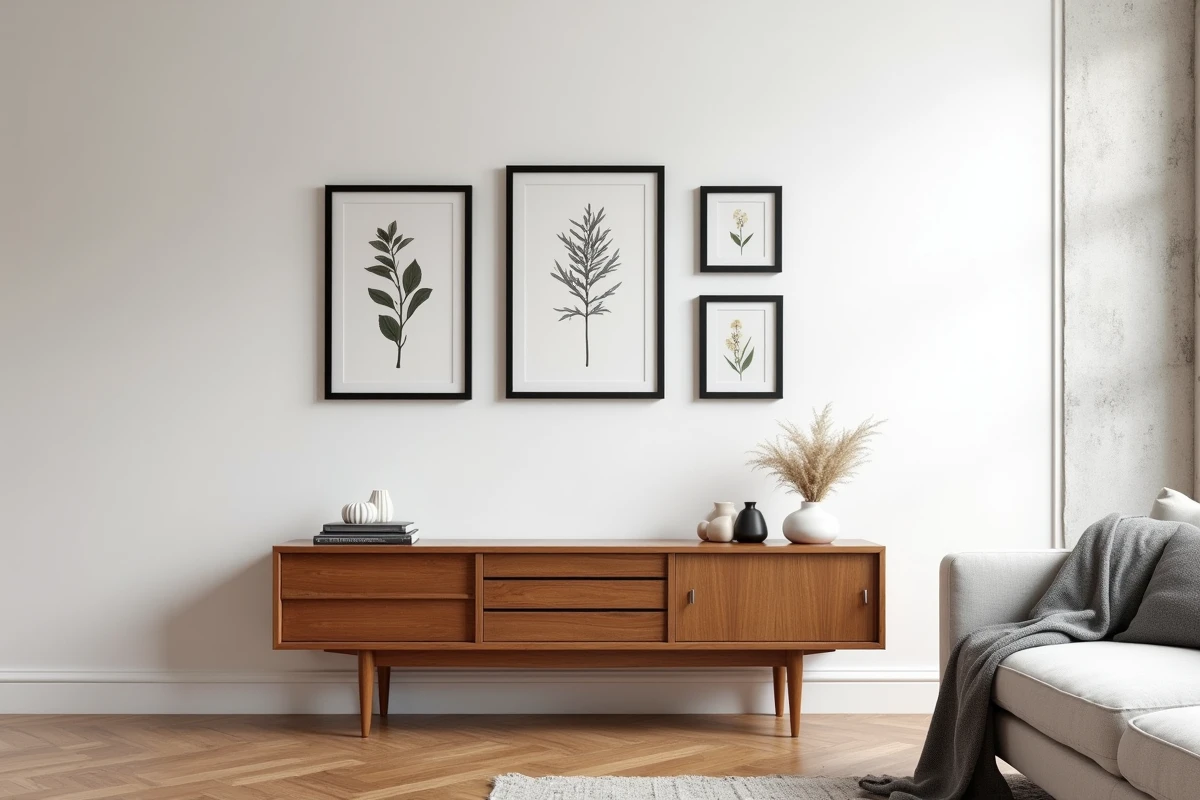
Five identical frames on a wall is an exercise in precision before being an exercise in decoration. The slightest deviation in spacing or height is immediately noticeable because the eye compares rigorously similar shapes. Here we share the technical points that make the difference between a controlled composition and an approximate alignment.
Lighting and identical frames: the parameter that most guides ignore
Light alters the perception of a series of frames much more than the choice of wall or the color of the mat. The C2RMF (Center for Research and Restoration of Museums of France) reminds us in its 2022 note that grazing light creates shadows and visual distortions on frames and mats. With five identical pieces aligned, this flaw multiplies.
We recommend positioning the frames parallel to a soft lateral light source, such as a wall lamp or adjustable LED rail. The goal: to eliminate localized reflections on the glass and achieve a uniform reading across the entire series.
A direct frontal light (recessed ceiling spotlight) casts a light cone that does not cover the extreme frames in the same way as the central frame. The result is a composition where the two side frames appear darker, breaking the desired symmetry. Before drilling, turn on your usual light sources and observe the reflection areas on the bare wall.
To arrange 5 identical frames on a wall without unpleasant surprises, this light diagnosis takes less than five minutes and avoids a complete repositioning after installation.
Spacing and height of frames: the technical dimensions to respect
The spacing between identical frames conditions the entire composition. If too tight, the whole forms a compact block that is difficult to read. If too wide, the frames float and lose their visual connection.
We apply a simple rule: the space between two frames should represent about one-tenth to one-fifth of the width of the frame itself. For a frame that is 40 cm wide, this gives an interval between 4 and 8 cm. Below this, the moldings almost touch. Above this, the eye no longer perceives a series but isolated elements.
Midline and hanging height
The hanging height is based on the visual center of the frame, not on the hook. The center of the middle frame is set at eye level, which is between 150 and 160 cm from the floor in a living space where one stands. In a hallway, this measurement works well. Above a sofa or console, we lower the visual center to about 140 cm from the floor so that the composition interacts with the furniture.
- Measure the total height of the frame, divide by two, then add this value to the desired visual center height: you get the hook hanging point.
- Transfer the chosen horizontal spacing using a cardboard template cut to the exact dimensions of the frame, fixed to the wall with repositionable tape.
- Check the horizontality with a laser level rather than a traditional bubble level: over five hanging points, the cumulative error of a short level becomes visible.
Arrangement in a living room or hallway: adapting the geometry to the space
A horizontal line of five frames works on a wide living room wall, above a corner sofa or a low piece of furniture. The composition follows the length of the furniture and structures the gaze.
In a hallway, this same horizontal line poses a problem of distance. The gaze is too close to the wall to take in five frames at once. In a narrow hallway, a staggered or cross arrangement gives a better visual result because it concentrates the composition on a more compact surface, readable even at short distance.
Three proven configurations for five frames
- Horizontal line: five frames aligned on the same axis, with regular spacing. Ideal above a long piece of furniture in a spacious living room.
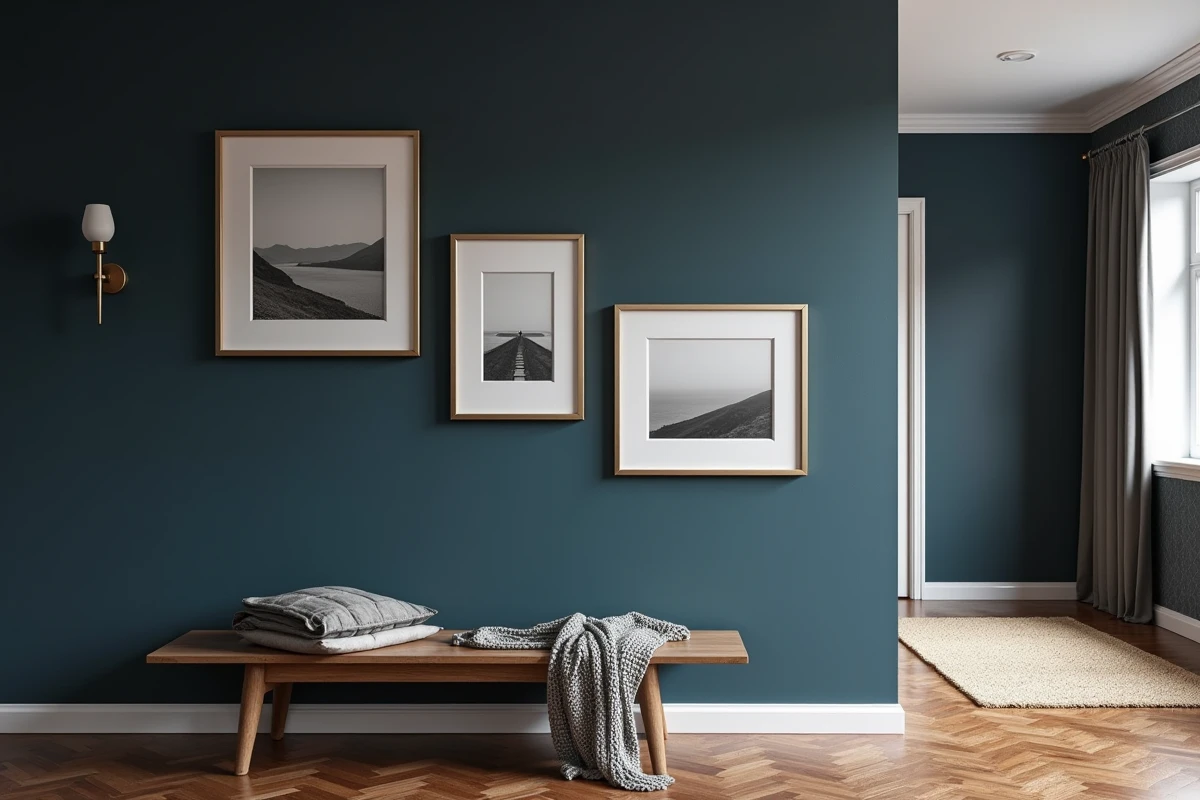
- Asymmetrical cross: one central frame, two frames offset at the top and two at the bottom (or vice versa). Suitable for hallway walls or narrow vertical spaces.
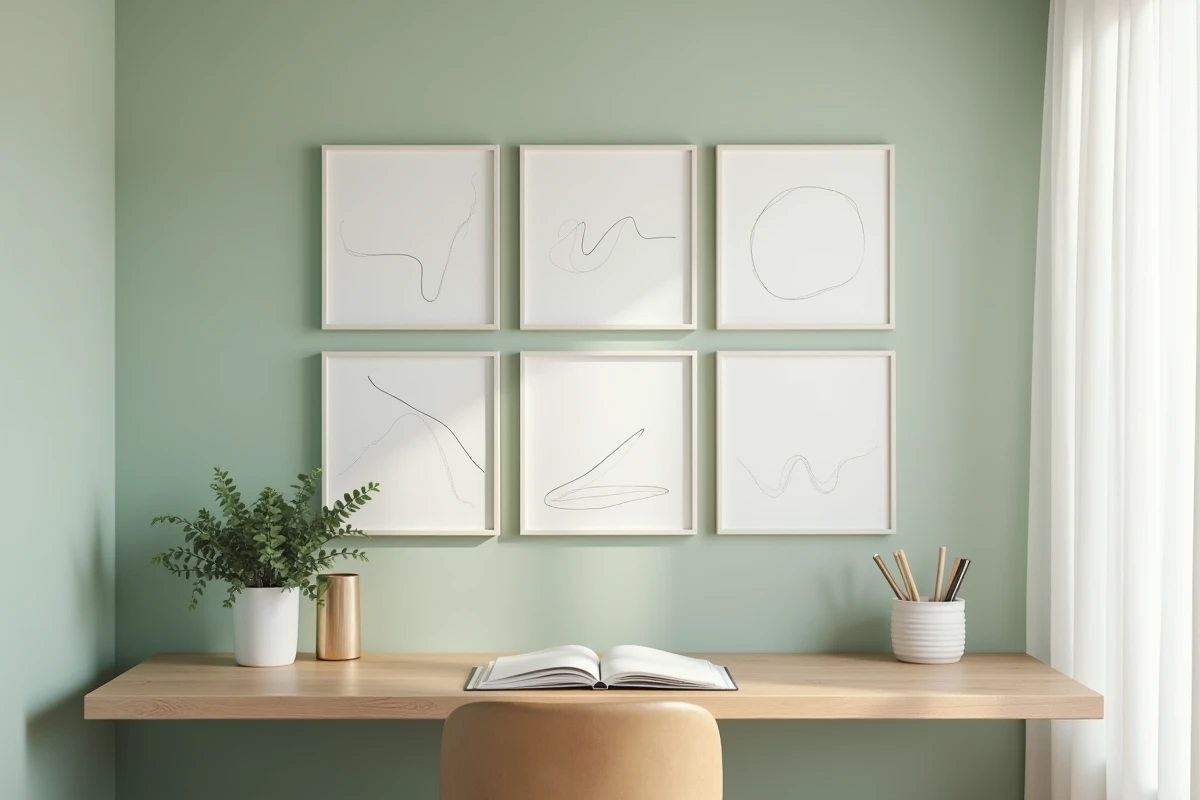
- Grid 2-3: two frames in the upper row, three in the lower row (or vice versa). This arrangement creates a compact visual block that works in a bedroom or office, above a desk or headboard.
Fixing and ground template: the method to avoid misdrilling
We regularly observe compositions ruined by poorly placed holes, filled with putty and then repainted, resulting in a visible outcome up close. The most reliable solution remains a full-size template placed on the ground before any intervention on the wall.
Cut five rectangles of kraft paper to the exact dimensions of your frames. Arrange them on the ground with the chosen spacings. Adjust until satisfied, then stick the whole thing on the wall with masking tape. Mark the fixing points through the paper. Drill.
Choice of fixing according to the support
On standard plasterboard (BA13), a simple nail holds a light frame. Once the frame exceeds a certain weight (solid wood frame with glass), an expansion plug or a Molly plug is necessary. On stone or solid brick walls, a nylon plug with screw is sufficient in most cases.
Five identical frames amplify the slightest alignment error. A one-millimeter gap between two frames goes unnoticed. A three-millimeter gap in height is immediately noticeable because the gaze uses the neighboring frames as a reference. The laser level drawn across the entire width of the composition remains the best ally.
The color of the wall also plays a role that is often underestimated. A white wall highlights dark frames but reveals every shadow cast. A colored wall absorbs more light and softens small flatness defects. Adapting the wall color to the finish of the frames allows for a controlled contrast without overloading the visual space.
One last point rarely addressed: ADEME notes in its guide on acoustic comfort (2023) that a wall covered with glassed frames accentuates sound reverberation in living spaces. If your living room already has a hard floor and little textile, five glass frames add reflective surfaces. Choosing anti-reflective glass or matte plexiglass reduces both light reflections and, marginally, sound reflection.